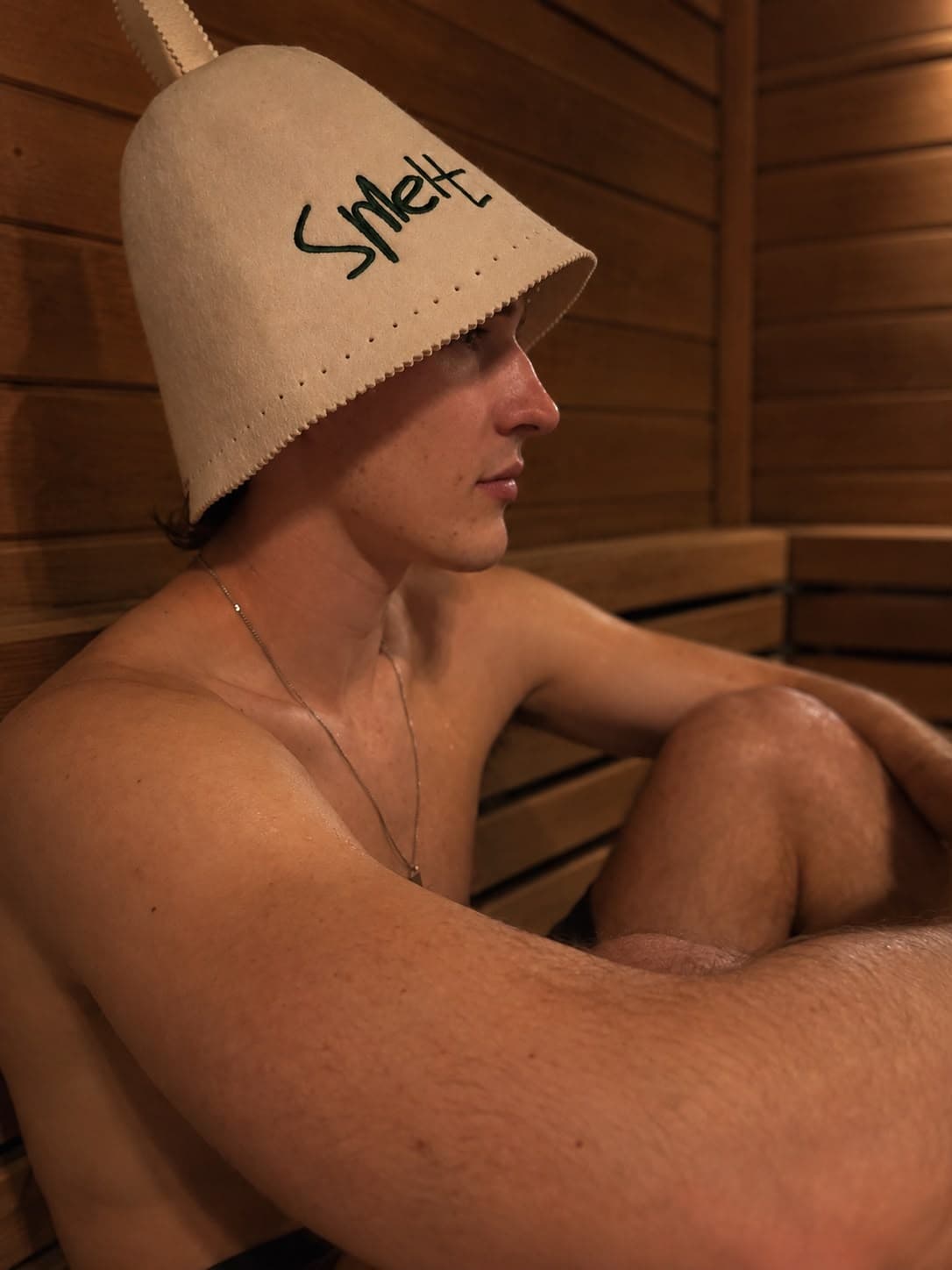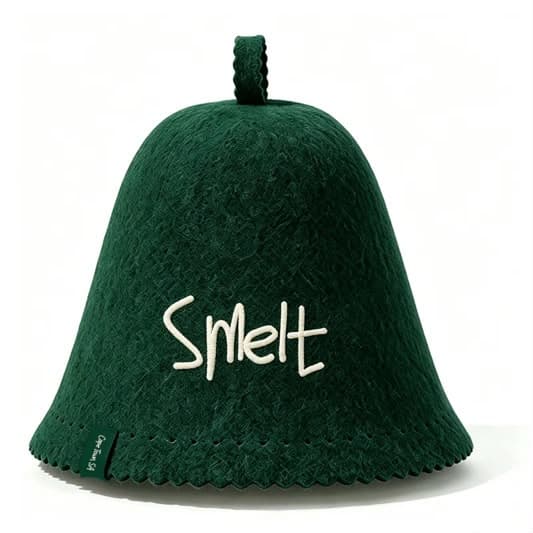
The 60-second checklist
If you only read one section, read this one. Everything below is the reasoning behind it.
- Material: 100% wool felt. Not a blend, not knit, not cotton, not fleece.
- Thickness: hold it up to a light. If the light comes through, it is too thin.
- Fit: it should sit low and loose over your ears, not grip your head.
- Decoration: embroidered thread only. Walk away from printed or vinyl graphics.
- Hardware: no metal badges, eyelets, rivets or snaps anywhere on it.
- Seams: as few as possible, and none across the crown.
- Care: air-dry only, hand spot-clean, never machine wash.
Material: what to insist on
The label should say 100% wool, and the construction should be felt. That combination does almost all of the work, and we've written up why wool specifically if you want the full reasoning.
Be suspicious of 'wool blend'. It is a legal description that can cover a hat with a minority of wool in it, and whatever makes up the rest is usually polyester, which reintroduces the melting risk and the permanent-smell problem. If a listing won't tell you the exact composition, that is itself the answer.
Thickness is the thing photos hide. A sauna hat works by putting a depth of trapped air between the room and your scalp, so there is no substitute for actual material. Our rough test: hold the felt up against a window or a lamp. Decent sauna felt is opaque. Thin craft felt glows.
- Good: 100% wool felt, opaque, firm but still pliable, a few millimetres thick.
- Avoid: wool blends, knitted beanies, cotton caps, polyester fleece, anything with a coated or shiny surface.
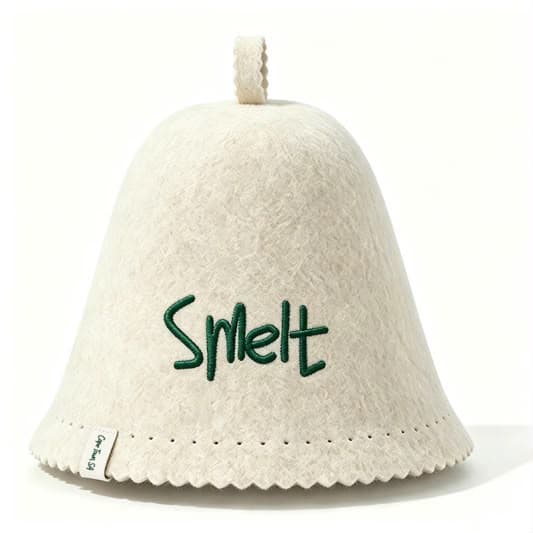
Fit: loose, low, over the ears
The instinct is to want a snug fit, and it is exactly backwards. A hat that grips your skull compresses the felt, and compressed felt has fewer air pockets, which amounts to a thinner hat. It also pulls the brim up off your ears, which are the part that hurts first.
What you want is a relaxed shape that sits down over the tops of your ears and settles rather than clamps. Felt has natural give, so a well-made one-size shape genuinely does land on a wide range of heads. The photo below is the same hat on two very differently sized heads.
Three things to check once you have one on. Does it cover your ears, or stop above them? Can you get a finger between the felt and your forehead without it feeling tight? Does it stay put when you tip your head forward, without you reaching up to adjust it? If all three are yes, that's the fit.
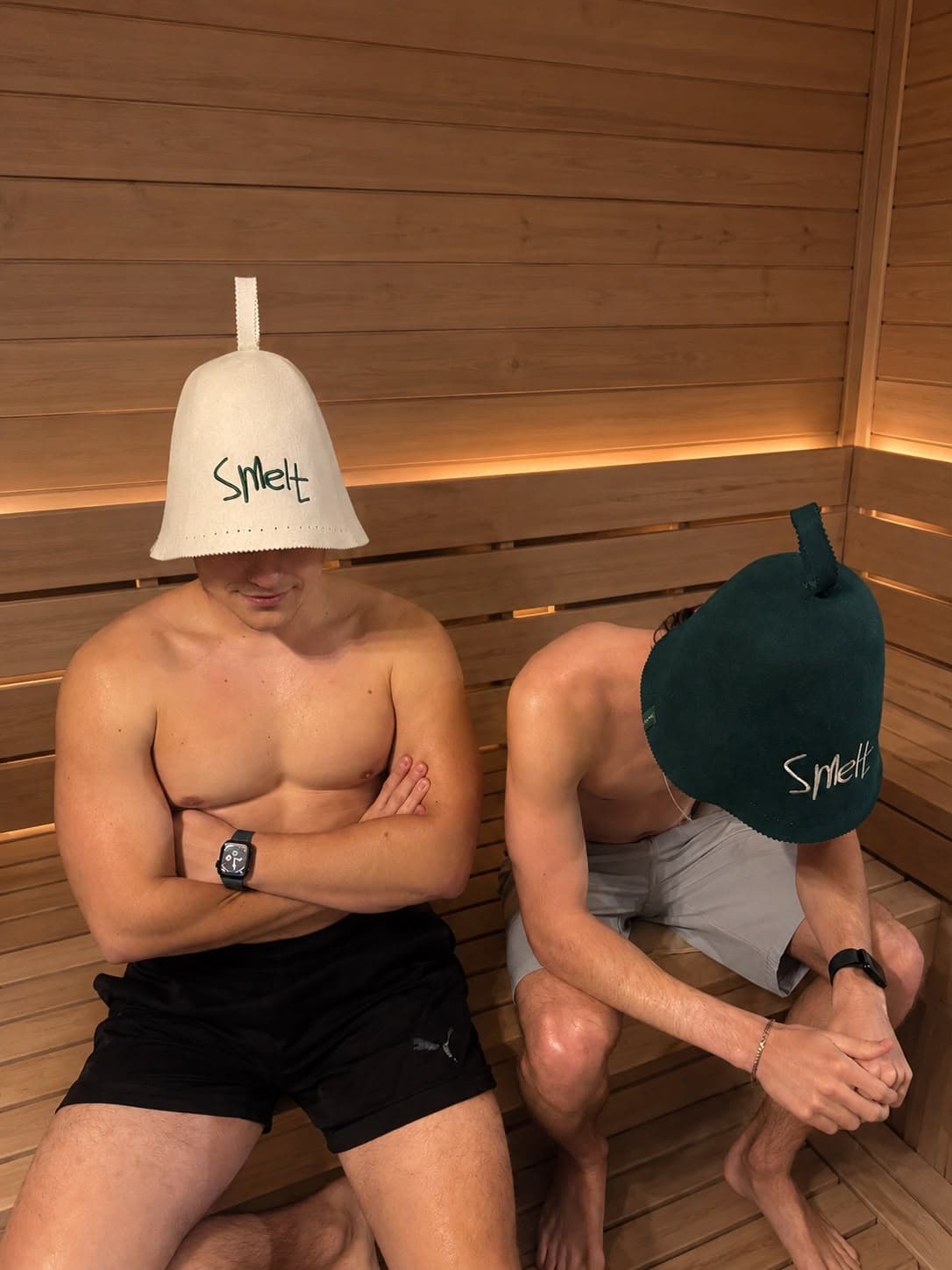
Fit edge cases
A few situations come up often enough to be worth naming.
Long hair: tie it up and put it under the hat rather than letting it hang out the back. Hair outside the hat takes the full heat, which is most of the reason people's hair suffers in a sauna. A bun under felt is the move.
Very large or very small heads: a one-size felt shape has more range than a sized fabric cap, but it is not infinite. If you are at an extreme, the honest check is whether the brim still reaches your ears without strain.
Shaved or thinning heads: you will feel the benefit more than most, and you can go slightly looser, because there is no hair bulk taking up room under the felt.
Construction details that actually matter
Most sauna hat failures are not material failures, they are detail failures.
Decoration is the big one. Printed and vinyl graphics are plastic films sitting on wool, and they expand at a different rate to the felt under repeated heat cycles. They crack, then they lift, then they peel off in the room. Embroidery is thread through felt, and it moves with the material, which is why everything on our hat is stitched, front and back, and nothing is printed.
Metal is the one people miss. A metal badge, eyelet, rivet or snap sitting on a hat in a 90°C room becomes a small hot object pressed against your head. There is no good reason for any metal on a sauna hat.
Seams and linings: fewer seams is better, and no seam should run across the crown, because a seam is a thin line in your insulation exactly where the heat is worst. Separate linings tend to be a bad sign too: they are often synthetic, and they trap moisture between layers so the hat takes much longer to dry.
Care: be honest about what you're signing up for
A wool felt hat is low-maintenance but not no-maintenance, and the two rules that matter are both about heat and water.
Rule one: air-dry, always. Press the excess moisture out rather than wringing it, reshape it with your hands while it is still damp, and leave it somewhere airy. No radiators, no hairdryers, no tumble dryers. Fast drying is what hardens and shrinks felt.
Rule two: never machine wash it. Agitation plus hot water plus detergent is the recipe for felting, and your hat will come out smaller, stiffer and permanently the wrong shape. When it genuinely needs cleaning, spot-clean by hand with cool water and a little wool-safe detergent, dabbing rather than scrubbing.
Honestly, most sessions need nothing beyond airing it out. For the full routine, plus the fixes for smell, sweat marks and a hat that got stored damp, see the care guide.
What you're paying for
Sauna hats span a wide price range, and the cheap end is cheap for identifiable reasons: thinner felt, blended fibre, printed branding, and a shape that doesn't hold.
The things that cost money are the things that make it work. Denser, thicker 100% wool felt. Embroidery rather than print. A shape cut and finished to sit over ears rather than perch on a crown. Those are also the things you can't assess from a product photo, which is why composition and thickness are worth asking about directly before you buy.
The flip side is that a good one is close to a one-time purchase. Looked after, it outlasts years of sessions, which is a different calculation from a cheap hat you replace every season.
What we chose, and why
We built the Smelt hat after failing to buy a decent one in South Africa, so every decision above is one we had to make ourselves rather than one we're describing from the outside.
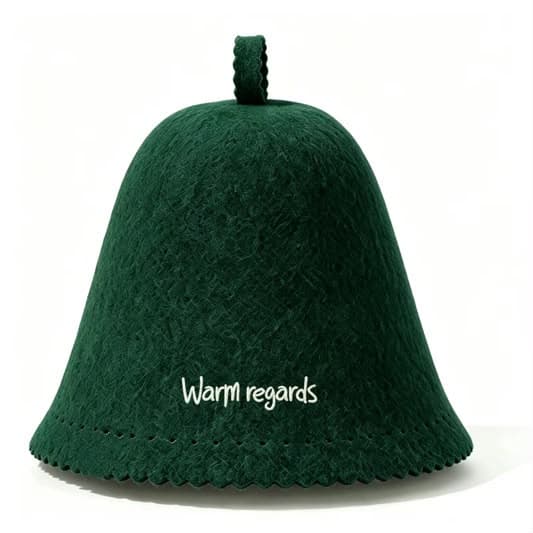
We make one hat, in two colourways: Forest Green and Natural Cream. It is 100% wool felt with no blend. It is a single relaxed one-size shape, because we'd rather one hat genuinely sit right on most heads than offer sizes that are a guess at checkout. Everything on it is embroidered: 'Smelt' on the front, 'Warm regards' on the back. There is no metal on it anywhere.
We're not going to pretend that's the only correct set of answers. But if you run the checklist at the top over any hat you're considering, including ours, you'll avoid the ones that don't work.