The short answer
Because a sauna is the worst possible environment for almost every other fibre. It is hot, it is wet, there is an open stove in the corner, and whatever you wear is going to be soaked in sweat and then expected to be fine again by Thursday. Wool is the one material that handles all four of those at once.
Tradition gets the credit, but the tradition exists because the material genuinely holds up. Finnish and Russian sauna culture settled on wool felt centuries before anyone had a phrase for thermal conductivity.
Property one: it insulates because of the air, not the fibre
Wool fibres are naturally crimped, kinking rather than lying flat, so a mass of wool is mostly trapped air by volume. Still air is a genuinely poor conductor of heat, and that trapped air is what slows heat moving from the room into your scalp. The wool is really just the scaffolding that holds the air in place.
This is why thickness and density matter more than the brand on the label. Thin felt has fewer air pockets and gives you less delay. Over-dense felt loses the pockets to compression, gets heavy, and takes an age to dry. There is a sweet spot, and finding it was most of our sourcing work.
Property two: it handles sweat without going clammy
Wool can absorb around 30% of its own weight in moisture into the fibre itself before the surface feels wet to the touch. In a sauna that is the difference between a hat that stays comfortable and a hat that becomes a hot wet rag on your head twelve minutes in.
There is a bonus: when wool takes on moisture it releases a small amount of heat, and when it gives that moisture back up through evaporation it absorbs energy from its surroundings. The evaporation happens at the outer surface of the felt, so that energy comes out of the hat rather than out of your scalp.
Wool also keeps insulating while damp, because the air pockets don't collapse. That property alone disqualifies most of the alternatives.
Property three: it does not melt
This is the one people never think about until they picture the room properly. A sauna has an exposed stove with rocks on it at several hundred degrees. Things get knocked, water gets thrown, people reach across.
Wool is unusually flame-resistant for a textile: it has a high ignition temperature, it tends to self-extinguish rather than sustain a flame, and critically it chars instead of melting. Synthetic fibres do the opposite: polyester and nylon soften and then melt, and melted synthetic sticks to skin. Wool near heat gives you a scorch mark and a bad smell. That is a very different kind of bad day.
Property four: it does not start to smell
A sauna hat lives its whole life wet with sweat. Wool is remarkably forgiving about this. Its surface structure and residual lanolin make it inhospitable to the bacteria that actually produce body odour, and it off-gasses as it dries rather than holding the smell in.
In practice ours get aired out after every session and genuinely cleaned very rarely. A polyester equivalent would need washing constantly and would still carry that permanent gym-kit smell within a month. What cleaning actually looks like is on the care page.
Why not cotton
Cotton is the most common wrong answer, usually because someone has a cotton towel on their head and assumes a cotton cap would do the same job better.
Cotton wets out instead of absorbing into the fibre. Once saturated, the air pockets fill with water, and water conducts heat roughly twenty-five times better than air does. Your insulator has just become a conductor sitting directly on your scalp. The experience is specific and unpleasant: fine for three minutes, then heavy, then like a hot compress.
Cotton also takes a long time to dry, which is how towels and cotton caps left in a sauna bag end up mildewed.
Why not synthetics
Polyester fleece looks like a reasonable substitute on paper: cheap, insulating, fast-drying. In a sauna it fails on two counts. The melting point is in the wrong place for a room with a stove in it, and the odour problem is permanent in a way no amount of washing fixes.
There is also a comfort issue that is harder to quantify. Synthetic fleece against a hot, sweating scalp feels slick and plasticky. Felt feels dry even when it isn't. That is not marketing; it is the moisture-absorption property doing something you can feel.
- Melts rather than chars, which is the wrong failure mode near a stove.
- Holds odour-producing bacteria, so the smell becomes permanent.
- Feels wet and slick on the scalp as soon as it is damp.
- Often finished with coatings or printed graphics that degrade under repeated heat.
Why felt rather than knitted wool
Wool is necessary but not sufficient, because the construction matters as much as the fibre. A knitted wool beanie is wool, and it is still the wrong thing, because knitting is a structure made of holes. Heat and steam travel straight through the gaps between stitches, and the first spot to give up is wherever the knit has stretched thinnest over your crown.
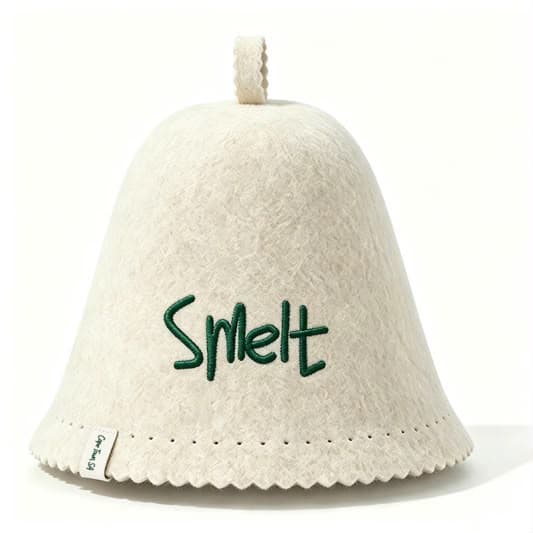
Felting mats the fibres together under heat, moisture and pressure into a single continuous sheet. No stitches, no holes, no seams running across the top of your head where you most need coverage. It also holds a shape: felt dries back into the form you reshaped it into, which is why a felt hat still looks like a hat after two years and a knitted one looks like a sock.
What we learned buying felt
We went through a frustrating number of samples. The useful lessons were all about density and honesty.
Thin felt is the most common problem: it looks the part in photos and gives you almost no delay in the room. Blends are the second: anything with polyester in it to cut cost reintroduces every synthetic problem above, and 'wool blend' on a label can mean almost anything. We ended up specifying 100% wool with nothing else in it, which is why our hat says exactly that and nothing vaguer.
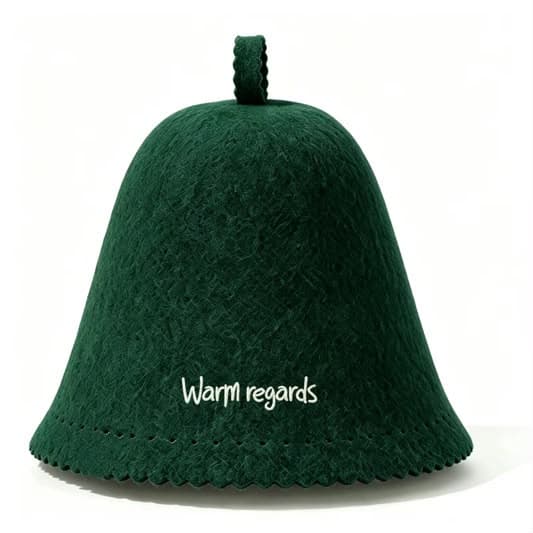
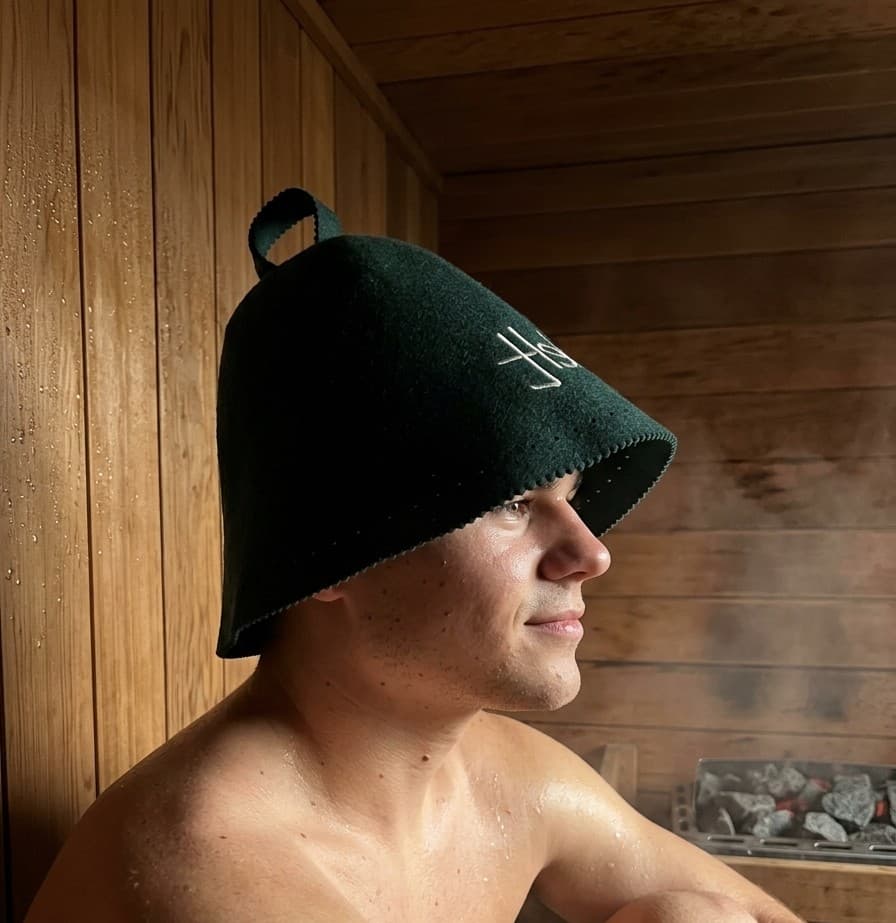
One more: decoration. Early on we looked at printed branding because it is cheaper and faster. Plastisol and vinyl prints crack and peel under repeated sauna heat, because they are plastic films sitting on wool, expanding and contracting at a different rate. Everything on our hats is embroidered thread, front and back, for exactly that reason.